|
| Torâh | Haphtârâh | Âmar Ribi Yᵊhoshua | Mᵊnorat ha-Maor |
|---|---|---|---|

(25.17-22)
 Assyria 9th or 8th century Ivory 539x484.gif "Keruv") |
| B.C.E. 9th-century Iraqi ivory plaque, derived from Egyptian pattern, depicting a כְּרוּב. |
 |
| "Moses" |
|---|
The derivation of the term (see 5764, below) provides a general framework within which to relate to the figure in the ancient world. However, the Egyptian understanding of this figure was markedly different from the Iraqi (Mesopotamian, Babylonian) understanding. In this connection, we must remember that the two figures on the אָרוֹן הָעֵדוּת were designed by, and constructed under, the supervision of Mosh•ëhꞋ—Moses, who was raised as an Egyptian prince in the royal family of Pharaoh Tut-Moses whose first (Egyptian) name isn't mentioned in the extant literature. Therefore, it is the Egyptian understanding of this figure that is relevant.
As will become evident in my forthcoming [since published] docunovel, The Mirrored Sphinxes Live-LinkT  (which I designed to be fun to read, in contrast to the rather academically-oriented educational books I've written to date), the ancient Egyptians called this figure
Hōr-em-akht (HōrꞋus in the horizon), not "cherubim" (or sphinx, see 5764, below).
Horus, it turns out, was a key to the relationship between the Hebrew (Israeli) infant found in the papyrus reeds of the Nile and the Egyptian princess who found him and adopted him.
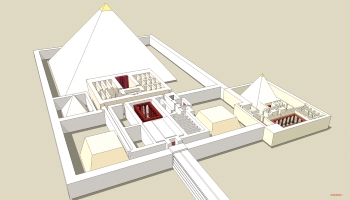 |
 Stone pyramid complex from the Old Kingdom, ca. BCE 2686-2181. Tomb-temple of a Par•ohꞋ- mountain (pyramid). When this architecture failed to conjure the Par•ohꞋ- |
 Khat-shepset temple-in-mountain 0250x167.jpg "Temple of Khat-shepset") |
 Khat-shepset temple-in-mountain 1840x1232.jpg "Click to enlarge") Par• |
Neither is it mere coincidence that the model for the original and revolutionary concept of a "Holy of Holies," which Mosh•ëhꞋ designed into Israeli worship, is first found in the mortuary temple of Egyptian princess & Pharaoh Khât-Tut-Moses. Why was the innovation of a "Holy of Holies" essential? How is that one of the keys that can enable us to communicate with
 of Idu, Giza 200x256.jpg "False door, Mastaba (Tomb) of Idu, Giza") |
| Stela – stone "false door" into mountain depicts spirit- |
The ancient Egyptians, including Mosh•ëhꞋ, understood Hor-em-akht to be the guardian of the entrance (i.e., protecting the holiness of the entrance) to the netherworld—i.e. the spiritual or divine world. So why did Mosh•ëhꞋ place two of these figures, face-to-face, on top of the אָרוֹן הָעֵדוּת? Why did they form only the crown / lid of the אָרוֹן הָעֵדוּת? Perhaps most importantly to us today, what were the keys that activated a link for Mosh•ëhꞋ to communicate from our physical world into the spiritual world of .
 |
 |
The derivation of the term כְּרוּב (m.n., pl. כְּרֻבִים) and the modern image are two separate, and unrelated, issues.
The modern image derives from Middle Ages Europe, has no connection to the Bible and is anthropomorphic and Hellenist in origin.
כְּרוּב is derived from the Akkadian karibu, meaning one who blesses. (The modern, unrelated, meaning in Israel is "cabbage.")
The various Biblical descriptions of כְּרוּב match up this ancient Iraqi- (Babylonian) derived term—where Av•râ•hâmꞋ Âv•iꞋnu lived—to some of the various versions of the Egyptian כְּרֻבִים (which included winged versions). To state this chronologically, the Middle Ages European term "sphinx" comes not from the ancient Egyptian or Akkadian "one who blesses" idea, but from a Hellenist (Greek) "strangler" (cognate of sphincter) myth. Modern Egyptologists are prone to wrongly use the Greek term, which conveys an opposite idea.
Modern people more likely begin to relate to the Middle Ages European image and term, according to which the objects on the lid of the אָרוֹן בְּרִית
|
|
This pâ•râsh•âhꞋ begins:
וַיְדַבֵּר
י--ה
אֶל-מֹשֶׁה
לֵּאמֹר:
דַּבֵּר
אֶל-בְּנֵי-יִשְׂרָאֵל,
וְיִקְחוּ-לִי
תְּרוּמָה;
 Assyria 9th or 8th century Ivory 300x269.gif "ccc") |
 Assyria 9th or 8th century Ivory 539x484.gif "Click to enlarge") |
25.18—"You shall make two gold כְּרֻבִים."
For millennia many have wondered what the כְּרֻבִים looked like. The short, historical and scientific, answer is that they were four-faced כְּרֻבִים (cf. also Yᵊsha•yâhꞋu ha-Nâ•viꞋ 6 and Yᵊkhëz•qeilꞋ ha-Nâ•viꞋ 1 & 10). The historical depictions of כְּרֻבִים is widely documented in the Middle East and dates from the Egyptian slavery of the Habiru and perhaps earlier.
More interesting are the questions which haven't been asked. Why wasn't there only one larger כְּרוּב? Or twelve smaller כְּרֻבִים? What do the כְּרֻבִים symbolize? How do the כְּרֻבִים relate, symbolically, to the אָרוֹן הָעֵדוּת, also called the אָרוֹן בְּרִית
There were two items of physical evidence: the stone tablets upon which were chiseled the עֲשֶׂרֶת הַדִּבְּרוֹת, the jar of man and the almond staff that blossomed. Why three items? And what do they symbolize?
Obviously, the עֲשֶׂרֶת הַדִּבְּרוֹת represents the entirety of Tor•âhꞋ, while inscribing them on two tablets symbolizes Tor•
The man clearly symbolized that
 |
 Blossoming Almond Branch |
Less obvious, perhaps, is the cut rod which blossomed endorsing the selection of the chosen spokesmen. The cut rod which blossomed symbolizes the
The symbolism, then, is of Tor•âhꞋ and the
The two כְּרֻבִים, then, represent the two comings of the
Because Tor•âhꞋ shë-bi•khᵊtâvꞋ (then, the two
יִּצְהָר was only regarded as fresh for one week. In ancient times this most precious freshly pressed oil was rushed to the Beit-ha-Mi•qᵊdâshꞋ in
 |
| Lapis lazuli |
Who is seated upon the two כְּרֻבִים (which symbolize the two comings of the
Consider, in this Light, Yᵊkhëz•qeilꞋ ha-Nâ•viꞋ 10.1: "Then I saw, and look, toward the sky which is over the head of the כְּרֻבִים [was something] like a lapis lazuli stone; and like in its appearance the form of a bench (judge's bench in a Beit-Din; a seat, or throne), appeared above them."
In the interim (emanating from between the כְּרֻבִים / comings of the
|
|
וְיִקְחוּ-לִי תְּרוּמָה; מֵאֵת כָּל-אִישׁ אֲשֶׁר יִדְּבֶנּוּ לִבּוֹ,
In order to render agricultural produce grown in Israel חֻלִּין, the produce had to have allocated from it the מַעַשׂרוֹת and תְּרוּמוֹת in the following manner: first tᵊrum•âhꞋ was set aside for the note 23.23.2), either to one's khag or to poor Jews in Israel ("Terumot and Ma'aserot," Ency. Jud., 15.1025). The "poor man's tithe" in the Diaspora was certainly channeled exclusively to "the poor of Israel" (authentic
Produce from which
 |
 Denarius (Caesar Augustus Tiberius) |
In the 1st or 2nd centuries CE, following the corroborating paradigm of livestock in wa-Yi•qᵊr•âꞋ the duty of giving מַעַשׂרוֹת was also extended from livestock and agricultural commodities to income in money. This was, in fact, the issue to which note 22.16.1) who presented him with a coin bearing the image of Caesar.
During this same period, מַעַשׂרוֹת were directed to the
The time for payment of מַעַשׂרוֹת and תְּרוּמוֹת was, apparently, during the khaj•imꞋ, in accordance with Shᵊm•otꞋ 23.15, 34; 34.20 & Dᵊvâr•imꞋ 16.16: "and they shall not appear before My Face empty."
There is ample evidence that מַעַשׂרוֹת and תְּרוּמוֹת were set aside in the Diaspora as well' It may be assumed that this applied in the Diaspora as a whole (EJ, loc. cit., 1028).
There are also four categories of Jews who are required to present a Tod•âhꞋ offering of Mi shë-bei•rakhꞋ, and for recognized non-Jew geir•imꞋ to sponsor, where viable, a Mi shë-
Recovered from an illness or survived or escaped some real danger (burglary, home invasion, robbery, mugging, etc.)
Been released from prison, kidnapping or hostage
Returned safely from a trip, and /or
Returned safely from the sea.
Other special occasions such as births and marriages, are also cause for Jews to offer a Mi shë-
|
|
25:9— אָדָם was created in the image of Ël•oh•imꞋ, not in some new and unique image of his own, or of his own making. Similarly, his relationship to Ël•oh•imꞋ is constrained by Ël•oh•imꞋ to the תַּבְנִית of the workings in the non-dimensional Realm (i.e., the "Realm of the heavens").
From the design of the Beit-ha-Mi•qᵊdâshꞋ hâ-Rishon down to each utensil used in its service, the manner of liturgy and tᵊphil•âhꞋ is required to conform to the תַּבְנִית compatible with the workings in the non-dimensional Realm of Ël•oh•imꞋ.
Worship derived from the vain imaginings of אָדָם (individuals following their own heart and their own eyes; bᵊ-Mi•dᵊbarꞋ 15.29) rather than from the dictations of תַּבְנִית by Ël•oh•imꞋ through the Beit-Din system, is condemned as an affront—a תּוֹעֵבָה—to Ël•oh•imꞋ (Mi•shᵊl•eiꞋ Shᵊlom•ohꞋ 28.9).
This principle extends to include the prohibition against "borrowing"—more accurately syncretizing (assimilating)—any trappings of pagan worship (wa-Yi•qᵊr•âꞋ 18.3, 24; 20.23). All such trappings are outside the pale of, and alien and contradictory to, the תַּבְנִית dictated by Ël•oh•imꞋ.
Recently on the Internet, a Conservative Jew observed that he preferred using the term "acculturated" instead of "assimilated." At first, this sounded like a good idea. Why unnecessarily alienate those we're trying to retrieve to Ha•lâkh•âhꞋ?
The downside, however, is that "acculturated" sounds innocent, just adapting to the local culture. Yet, Mi•shᵊl•eiꞋ Shᵊlom•ohꞋ defines it as a תּוֹעֵבָה. This is no different than redefining homosexuality as merely "loving one's neighbor." It sounds socially acceptable—and politically correct—but the aveir•âhꞋ of Tor•âhꞋ remains a תּוֹעֵבָה (wa-Yi•qᵊr•âꞋ 18.22).
וִדּוּי of one's a•veir•otꞋ of Tor•âhꞋ is a prerequisite to תְּשׁוּבָה (wa-Yi•qᵊr•âꞋ 5.5; 26.40; bᵊ-Mi•dᵊbarꞋ 5.5-7; Mi•shᵊl•eiꞋ Shᵊlom•ohꞋ 28.14). Avoiding וִדּוּי by redefining an aveir•âhꞋ of Tor•âhꞋ as a socially acceptable and politically correct non-transgression precludes תְּשׁוּבָה.
Thus, dismissing syncretization of paganism into Tor•âhꞋ as mere "acculturation" would be a disservice to the transgressor in need of ki•purꞋ by whitewashing what Ël•oh•imꞋ, in His Tor•âhꞋ, has defined as a aveir•âhꞋ of His Tor•âhꞋ.
There are areas in which we can, and should, smooth their path to תְּשׁוּבָה.
First, as an example, the
 |
| "Carter Syndrome" (Enemies of Yi•sᵊ |
At first thought, this might seem to contradict 5.28.
Christian renderings, which have been redacted to retroactively support the Christian doctrine of "hopeless sinners" read "whosoever looketh on a woman to lust after her hath committed adultery with her already in his heart." The Christian doctrine perceives the mere temptation to constitute sin. (It's contradictory to equate Christian "sin" with aveir•âhꞋ of Tor•âhꞋ. Moreover, "sin" is an amorphous and undefined concept in Christianity.)
Accurately translated from the earliest extant source mss. however, NHM 5.28 properly reads: "everyone who beholds a woman and has designs upon her has, in his heart, already committed adultery with her."
In NHM we find that
There are other ways in which we can also smooth the path to דֶרֶךְ
This doesn't imply that Christians, other goy•imꞋ, or even estranged Jews, have arrived within the "city limits" of Ha•lâkh•âhꞋ and salvation (cf. Who Are The Nᵊtzarim? Live-LinkT (WAN)). They're not "saved." But if we focus on encouraging these travelers to continue on the path of logic, which inevitably leads to this City, then we will be commending them for the mi•tzᵊw•âhꞋ fulfilled, as a milestone on their journey, instead of condemning them for the mi•tzᵊw•otꞋ transgressed (not yet fulfilled). This approach attracts travelers into the City, whereas focusing solely on condemning the mi•tzᵊw•âhꞋ unfulfilled not only repels travelers outside the City, such condemnations are a symptom of a "holier than thou" sanctimony that has even driven away many residents of the City.
|
|
The concept of מַעַשׂרוֹת is coupled with תְּרוּמוֹת. "Although biblical law confines the duty of giving תְּרוּמוֹת and מַעַשׂרוֹת to grain, wine, and oil (cf. Dᵊvâr•imꞋ 12.17), – the sages deduced from the Bible that it applied to other produce and fruits and, according to the Ha•lâkh•âhꞋ, it was further applied to vegetables ("Terumot and Ma'asrot," Ency. Jud., 15:1025-28).
"Produce from which tᵊrum•âhꞋ and
Tithing of cattle, and presumably other kâ•sheirꞋ livestock, were treated as
 |
 Widow's mite |
"According to the Ha•lâkh•âhꞋ, the duty of setting aside מַעַשׂרוֹת and תְּרוּמוֹת did not apply outside eretz Yisraeil, following the principle: 'Every precept dependent on the land [of Israel] is in force only in that land' In fact, however, there is ample evidence that מַעַשׂרוֹת and תְּרוּמוֹת were set aside in the Diaspora as well." (EJ, ibid.)
"At the close of the tannaitic era the duty of giving tithes was extended to money as well" (EJ, ibid).
Money income, unlike vegetables, fruit trees, or livestock grazing on the land, is not dependent on the land of Israel. Therefore מַעַשׂרוֹת and תְּרוּמוֹת must be paid on one's income in the Gâl•utꞋ as well as in Israel.
The term is הַיִקְבַּע (i.e., "the [one] who shall cheat…"). Review further details in NHM note 23.23.2.
Answer: an English word designed to make
Well, at least that's the effect. The אָרוֹן הָעֵדוּת was the chest made of
The "ark" made by
There is no connection between אָרוֹן and תֵּבָה—except for the artificial connection of the English term "ark."
|
|
25.9 – כְּכֹל, אֲשֶׁר ִאֲני מַרְאֶה אוֹתְךָ, אֵת תַּבְנִית הַמִשְׁכָּן וְאֵת תַּבְנִית כָּל-כֵּלָיו; וְכֵן תַּעֲשׂוּ:
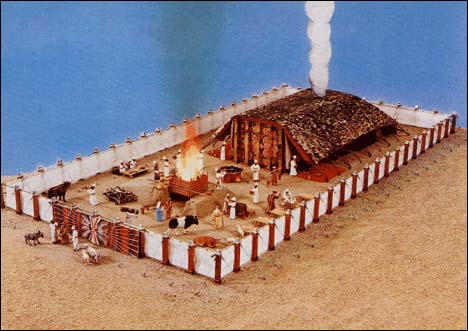 |
| The Weaning from Egyptology: Look ma, no accessing "spirits" in a "holy mountain" through a stone "false door" in the third, holiest, inner sanctum! The A•rōnꞋ hâ-Eid•ūtꞋ with The Mirrored Sphinxes Live-LinkT instead! Mi•shᵊkânꞋ / OꞋhël Mo•eidꞋ |
תַּבְנִית derives from בָּנָה. While it means model or pattern in modern Hebrew, it relates more directly to construction or structure in ancient Hebrew. Thus, we might think of it as an ancient counterpart of the modern blueprint or architectural model. (See related analysis of מִשְׁכָּן.)
מִשְׁכָּן is a masc. noun derived from שָׁכַן. This verb is popularly rendered settled down, dwelled or abode. However, there is a better term for settled [down] or abode: יָשַׁב. Cognates deriving from this
Terms deriving from שָׁכַן, by contrast, include שָׁכֵן and שְׁכֵנָה and שִׁכּוּן and שְׁכִינָה.
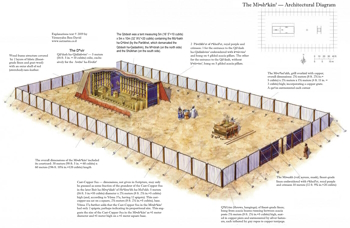 |
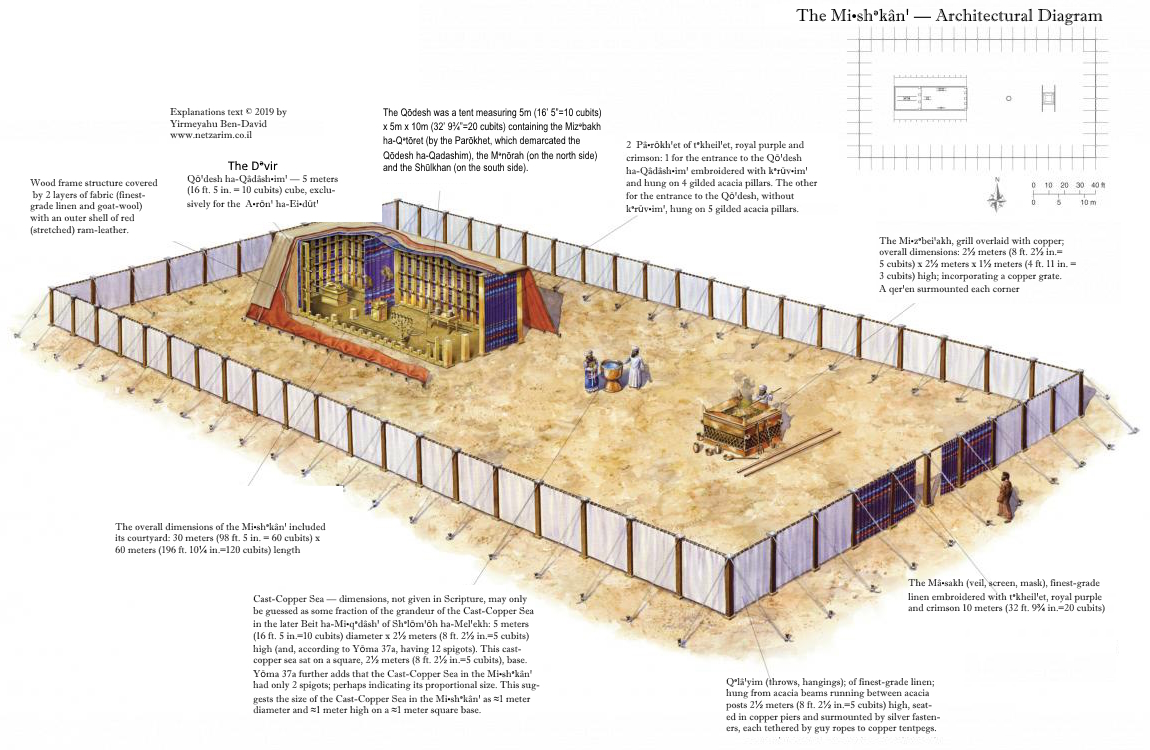 Mi•shᵊkânꞋ diagram |
Tal•mudꞋ notes (Ma•sëkꞋët Shᵊvu•otꞋ 16b) that מִשְׁכָּן is a synonym of מִקְדָּשׁ. However, "Tabernacle" is a poor rendering for מִשְׁכָּן, creating confusion with the totally unrelated term סֻכּוֹת, also pop. rendered "tabernacles."
Perhaps מִשְׁכָּן can best be thought of as a word reserved for "the (Divine) Neighbor's House." This dovetails with the concept of תַּבְנִית in that both emphasize the building of an earthly symbol / paradigm illustrating the important points of
 0250x188.jpg "Mishkan Ohel-Moeid (Timna courtyard)") |
 1136x852.jpg "Click to enlarge") Mi•shᵊ |
This, in turn, is corroborated by the anonymous Διαθηκη Καινη (NT) writer of Yᵊhud•imꞋ ("Hebrews," 7.28—8.5).
Though we don't regard the Διαθηκη Καινη (NT) book of Yᵊhud•imꞋ as authoritative, the historical insight can be helpful. Like the Essenes, the unidentified author of Yᵊhud•imꞋ criticized the Roman-appointed
Rather, the "true Mi•shᵊkânꞋ in the heavens which
The service of the earthly
Christians have interpreted this passage to mean that the "law" was abolished in order to establish a "better covenant" and a "better summons," the basis of "Displacement Theology" (aka Replacement Theology).
 |
 Ossuary of "Ko• |
The Judaic writer, by contrast, was conveying the following. The "
The "first covenant" described by
He then reasoned that the בְּרִית חֲדָשָׁה described by
This contradicts Christianity while corroborating the authentic teachings of
In the latter respect, 5.17-20).
The first bᵊrit is replaced not by a rival earthly religious bᵊrit (Christianity), but instead reverts our focus from the earthly realm back to the "originals" upon which our earthly Mi•shᵊkânꞋ and
Hence we find in Yᵊhud•imꞋ not a basis for "Displacement Theology" but, instead, a confirmation of Halakhic Judaism—the בְּרִית חֲדָשָׁה prophesied by
The author of Yᵊhud•imꞋ saw this as an inescapable conclusion resulting from [1] the abrogation of the genealogy law of the
For him, and for the Nᵊtzâr•imꞋ, this suggested that the only possible solution lay in the spiritual Realm. (Excerpts from Yᵊhud•imꞋ are paraphrased from The Nᵊtzâr•imꞋ Reconstrnction of An Anonymous Letter to the
|
|
The phrase in the second pâ•suqꞋ rendered "whose heart prompts him," or in other versions "willingly" is
יִדְּבֶנּוּ לִבּוֹ (whose heart "volunteers him," i.e., motivates him). As a reserve police officer here in Israel, I'm a מִתְנַדֵּב, which derives from the same
Mᵊlâkh•
פְּקֻדֹּת is from the same shorꞋësh (root) as פָּקִיד, the historical title of the Nᵊtzâr•imꞋ leaders.
Too often it is assumed that the blood ki•purꞋ requirement of wa-Yi•qᵊr•âꞋ 17.11, which, we believe,
Many Christian misconceptions are based on this misunderstanding. The Hebrew term for atonement, better described as expiation, is כַּפָּרָה. This term is related, through the verb כִּפֵּר, to כִּפּוּר. Yom ha-
In [some years,] this week's pâ•râsh•âhꞋ describes another aspect: the giving of the half-
|
|
25.18-20— This pâ•râsh•âhꞋ describes two כְּרֻבִים of hammered gold which were part of the gold lid of the A•
Soon after leaving Egypt, we should not be surprised to find some Egyptian influence leaving its mark on the Israelis.
 Mirrored kᵊruv•imꞋ (Hellenized to "cherubim") of the period (B.C.E. 9th-century Iraq; Iraqipages.com) |
While the "Sphinx" beside the pyramids is typical of the ancient כְּרוּב, the term "sphinx" is a misnomer that was unknown to Egyptians. "Sphinx" derives from the Greek, and means "strangler." According to Hellenist legend, a sphinx at Thebes strangled passers-by who were unable to guess its riddle. Hellenist sphinxes functioned rather like scarecrows in crop fields. The ancient term, כְּרוּב, by contrast, derives from the Akkadian karabu ( = to bless; according to Klein's).
The text describes a pair of winged-כְּרֻבִים facing each other. The body of a כְּרוּב was that of a lion. In this case, the paws of one כְּרוּב seem to touch the paws of the other כְּרוּב as they faced each other. Judging from Egyptian and Phoenician seals of the period, the faces seem to have been of men. The wings, then, rose straight up, over the heads of the כְּרֻבִים, and out in front of them to touch the wings of the opposing כְּרוּב.
It was from on this lid, between these כְּרֻבִים, that
|
|

For traveling, Mosh•ëhꞋ constructed a pre-fab "camper's model" מִשְׁכָּן—related to שְׁכִינָה. The מִשְׁכָּן was also called the אֹהֶל ("of Meeting" and, more accurately, of the שְׁכִינָה).
The Arabs have actively destroyed and removed every vestige they've been able to uncover (in addition to the recent news stories in The Jerusalem Post, see also the Biblical Archaeology Review, 1983.03-04, pp. 40-61).
Both structures were designed to be the repository, the safe-domiciling, of the אָרוֹן הַבְּרִית
Despite such hard evidence, as well as that
 |
 "Palestinian" Child Soldier– Fatah Parade, armed with real Uzi (Jerusalem Post, 2003.01.02) What do you think he's doing now? |
 |
| "Palestinian" Child Soldier – Baby Terrorist Martyr Suicide Bomber (Jerusalem Post, 2005.07.07) What do you think he's doing now? |
Meanwhile, the world which cares nothing for Ta•na"khꞋ is, judged by their inaction (as they will indeed be), sympathizing with those who popularized blowing up airliners and blowing up people in restaurants, insisting they're not misojudaic. Don't be judged with the world. Write your country's leaders and express your outrage, insist vocally and with tireless endurance, for as long as
|
|
6.12 —
הַבַּיִת
הַזֶּה
אֲשֶׁר-אַתָּה
בֹנֶה,
אִם
תֵּלֵךְ
בְּחֻקֹּתַי
וְאֶת-מִשְׁפָּטַי
תַּעֲשֶׂה,
וְשָׁמַרְתָּ
אֶת-כָּל-מִצְוֹתַי
לָלֶכֶת
בָּהֶם;
Where to place the present tense verb "to be," understood in Hebrew, in this sentence greatly affects the understanding. Most interpreters opt for the most superficial: "This House that you build'," which so misforms the intent in English that it cannot at all fit into the contextual puzzle. The correct interpretation both follows the cantillation and fits the context: "This is the House that you are building—if you walk in My khuq•imꞋ, and you will do My mi•shᵊpât•imꞋ, and you will watchkeep all of My mi•tzᵊw•otꞋ, to walk in them; (then I shall have upheld My Speakings with you, which I spoke to Dâ•widꞋ your father; and I shall cause My Shᵊkhin•âhꞋ to neighbor within Bᵊn•eiꞋ-Yi•sᵊr•â•eilꞋ; and I shall not abandon My kindred, Yi•sᵊr•â•eilꞋ).
Non-Jews typically misread such passages, attempting to inject their alien (non-Judaic / contra-Tor•âhꞋ) interpretation into the Judaic-authors, asserting that this implies being perfect, which is impossible for any human. That notion wasn't even conceived until millennia after the fact—when Christianity recognized that it needed some justification for rejecting Jews and Judaism. (Hence, the "reasoning" justification: since the "Law" is impossible to keep it must be displaced by the "grace of Christ"—Displacement Theology—or all men would be doomed.)
Commanding observance to laws which humans couldn't possibly obey is the key characteristic not of
Rather, Tor•âhꞋ, and 5.17-20). And the House, contrary to superficial eyes, was not the physical Beit ha-
|
|
3.1). He, too, began with the more detailed announcement: "חִזְרוּ בִּתשׁוּבָה [to Tor•âhꞋ]), for the Realm of the heavens has converged [with us]" (NHM 4.17). Once the two keys are identified, they become obvious in
|
|
"Great is the Ta•lᵊmidꞋ Tor•âhꞋ watchkeeping over and bringing mankind to fulfill and do all of the mi•tzᵊw•otꞋ'"
Compare this to the words of 5.19-20: "For whoever deletes one Oral Law from the Tor•âhꞋ, or shall teach others such, by those in the Realm of the heavens he shall be called "deleted." Both he who preserves and he who teaches them shall be called Rav in the Realm of the heavens. For I tell you that unless your tzᵊdâq•âhꞋ is over and above that of the so•phᵊr•imꞋ, and of the Rabbinic-Pᵊrush•imꞋ, there is no way you will enter into the Realm of the heavens!" (Cf. explanatory notes in NHM.)
|
|
| Tor•âhꞋ | Translation | Mid•râshꞋ RibꞋi Yᵊho•shuꞋa: NHM |
NHM |
||||||
|---|---|---|---|---|---|---|---|---|---|
| |||||||||
|
|
Great is the Tal•mudꞋ Tor•âhꞋ. It is a מורה [moreh; instructor, cognate of Tor•âhꞋ] and brings mankind to establish and practice all of the mi•tzᵊw•otꞋ.
As it is memorized at the end of the opening chapter of Qidushin (40.2), RabꞋi Tarphon and the seniors were already reclining in the upper-story of Beit Nitzah, in Lod, when this question was asked before them: 'Which is greater, Tal•mudꞋ Torah or Ma•as•ëhꞋ?' RabꞋi Tarphon answered and â•marꞋ, 'Ma•as•ëhꞋ is greater,' RabꞋi Aqiva answered and â•marꞋ, 'Tal•mudꞋ Torah is greater.' Everyone answered and â•marꞋ, 'Tal•mudꞋ Torah is greater because the Tal•mudꞋ causes Ma•as•ëhꞋ.' And great is Tal•mudꞋ, which precedes all of the mi•tzᵊw•otꞋ, as it has been memorized above.
It has been taught, RabꞋi Yosi says, "Great is Tal•mudꞋ." for khal•âhꞋ 40 years [in the wilderness], to make מַעַשׂרוֹת and תְּרוּמוֹת [two additional 7-year periods=] 54 [beginning the first Shᵊmit•âhꞋ], for Shᵊmitin [another 7-year period=] 61, for Yo•vᵊl•otꞋ [six additional 7-year periods=] 103.
103—Was it 104? [RabꞋi Yosi] holds the opinion that from the beginning of the Yo•veilꞋ one makes Shᵊmit•âhꞋ.
Just as the Tal•mudꞋ precedes Ma•as•ëhꞋ, so Din precedes Ma•as•ëhꞋ. According to Rav Hamnunâ, •marꞋ Rav Hamnunâ, "There is no beginning of the law of man other than Divrei Tor•âhꞋ." As it is written, "A breaking-free of water [i.e. in the desert, impossible to put back in a goatskin] is the start of a legal dispute." (Mi•shᵊl•eiꞋ Shᵊlom•ohꞋ 17.14). And just as the Din precedes the Ma•as•ëhꞋ, so His remuneration precedes the Ma•as•ëhꞋ. As it is written, "Then he gave them the lands of the goy•imꞋ and they inherited the toil of nations so that they could watchguard His khuq•imꞋ, etc." (Tᵊhil•imꞋ 105.44-45).
It's also memorized in the opening chapter of Ma•sëkꞋët Mᵊgil•âhꞋ (16.2), •marꞋ Rav Yosi , Greatest is the Tal•mudꞋ Tor•âhꞋ than the tᵊphil•âhꞋ of nᵊphâsh•otꞋ.
Of the intention to uproot Mârdᵊkhaiy according to 4, as it is written, "who came with Zᵊru-Bâveil: Yeishua, Nᵊkhemyâh, Sᵊrâyah, Rᵊeilâyâh, Mârdᵊkhaiy-Bilshân" (ËꞋzᵊr•â 2.2).
And in the end, the intention according to 5, as it is written, "who came with Zᵊru-Bâveil: Yeishua, Nᵊkhemyâh, Azaryâh, Ra•amyâh, Nakhamâniy, Mârdâkhaiy-Bilshân" (Nᵊkhëmyâh 7.7).
And •marꞋ Rav: Greater is Tal•mudꞋ Tor•âhꞋ than building the Beit ha-Mi•qᵊdâshꞋ, that all of the time that Bârukh Bën-Neiryâh existed, he didn't [allow] ËꞋzᵊr•â to rest. Then Rabâh Bar Bar Khân•âhꞋ, went up and •marꞋ Rav, Greater is Tal•mudꞋ Tor•âhꞋ than kâ•vodꞋ for father and mother, that all of the years that Ya•a•qovꞋ was with Eiver there was no punishment upon them, etc., as it is there.
It is also memorized in the chapter of Ma•sëkꞋët Sunedrion on concluding the Din (44b), •marꞋ RabꞋi Shᵊmueil Bar Iwyâ of Rav, Greatest is Tal•mudꞋ Tor•âhꞋ than the perpetual qor•bânꞋ It is written, "Now, I have come" (Yᵊho•shuꞋa 5.14), etc., as it is there.
But no more. Rather, such is he who is a great of Tor•âhꞋ that even an illegitimate child who is a sagacious ta•lᵊmidꞋ precedes every dâ•vârꞋ of a Ko•heinꞋ ha-Ja•dolꞋ who is an am hâ-ÂꞋrëtz. According to the crown (כתר, keter) of Tor•âhꞋ, the ascendant and great among all is like recited in Ma•sëkꞋët Ho•rây•otꞋ, the Ko•heinꞋ Mâ•shiꞋakh chapter (13a), "The Ko•heinꞋ precedes the Lei•wiꞋ, the Lei•wiꞋ [precedes] the Yisrâ•eili, the Yisrâ•eili the illegitimate child, the illegitimate child the Jivon•imꞋ servants of the Beit ha-Mi•qᵊdâshꞋ, the Jivon•imꞋ servants of the Beit ha-Mi•qᵊdâshꞋ the geir, the geir the freed slave."
When? At one time all of them are equal, but if an illegitimate child was a sagacious ta•lᵊmidꞋ and a Ko•heinꞋ ha-Ja•dolꞋ is an am hâ-ÂꞋrëtz then the illegitimate child who is a sagacious ta•lᵊmidꞋ precedes the Ko•heinꞋ ha-Ja•dolꞋ who is an am hâ-ÂꞋrëtz. And they said above in Gᵊmâr•âꞋ, From what source are these words? •marꞋ RabꞋi Khaninâ, •marꞋ he read, "she is more dear than pearls" (Mi•shᵊl•eiꞋ Shᵊlom•ohꞋ 3.15). From a Ko•heinꞋ ha-Ja•dolꞋ who enters you've studied this: that you have no crown (כתר, keter) greater than the crown (כתר, keter) of Tor•âhꞋ.
We have memorized, in "These are the Shᵊm•otꞋ Rab•âhꞋ, Before what in every utensil is it said "and you shall make" and in the hâ-Âron is written, "and you shall make an •ronꞋ" (Shᵊm•otꞋ 25.10)? •marꞋ RabꞋi Yᵊhud•âhꞋ Bar-Shâ•lomꞋ, "•marꞋ ha-QoꞋdësh Bâ•rukhꞋ Hu, 'Everyone came and busied themselves with the •ronꞋ in order that they would merit the Tor•âhꞋ.
•marꞋ RabꞋi Shim•onꞋ Bar-Yo•khaiꞋ, "There were three crowns (כתר, keter): the crown (כתר, keter) of Tor•âhꞋ, the crown (כתר, keter) of Kᵊhun•âhꞋ and the crown (כתר, keter) of the Malkhut (ibid. 24).
The crown (כתר, keter) of the Malkhut, this is the Shul•khânꞋ, as it is written in the same place (24), "a rim (זר, zeir) of gold." The crown (כתר, keter) of Kᵊhun•âhꞋ, this is the Miz•beiꞋakh, as it is written in the same place (30.3), "a rim (זר, zeir) of gold." {The crown (כתר, keter) of Tor•âhꞋ, this is the •ronꞋ, as it is written in the same place (25.11), "a rim (זר, zeir) of gold."
Why are they written זר (zâr; stranger) but read זר, (zeir; rim)? To tell you [something]? If an âdâm is worthy—we make a זר, (zeir; rim) for him. If he is unworthy—we make him a זר (zâr; stranger).
For what purpose are all of these written [thusly]: "And you shall make for it" (ibid., 25.24, 30.3), but by the •ronꞋ it's written, "and you shall make upon it" (ibid., 25.11)? To tell you that the crown (כתר, keter) of Tor•âhꞋ is the highest of all of them. The âdâm who is worthy by Tor•âhꞋ is worthy even of all of them.
It has been memorized in Ma•sëkꞋët Yom•âꞋ, the "Ko•heinꞋ ha-Ja•dolꞋ came to it" chapter (72b), •marꞋ RabꞋi Yo•khân•ânꞋ, "There are three זר, (zeir; rim): of the Miz•beiꞋakh, of the •ronꞋ and of the Shul•khânꞋ. Of the Miz•beiꞋakh, A•har•onꞋ was worthy of it and carried [the זר, (zeir; rim)]. Of the Shul•khânꞋ, Dâ•widꞋ was worthy and carried [the זר, (zeir; rim)]. Of the •ronꞋ, it is still being apportioned. Everyone [of Israel] who wants to carry [the זר, (zeir; rim)] may come and carry it. What does it say, "Whoever is least among them"? Tal•mudꞋ says, "By Me mᵊlâkh•imꞋ shall reign" (Mi•shᵊl•eiꞋ Shᵊlom•ohꞋ 8.15). You find it teaches that He is the mëꞋlëkh-maker, and the mëꞋlëkh-maker greater than a mëꞋlëkh.
We have recited in To•sëphꞋtâ, Greater is Tor•âhꞋ than the Kᵊhun•âhꞋ or the Malkhut. The Malkhut was purchased in 30 מעלות (ma•alot; steps or degrees), and the Kᵊhun•âhꞋ in 24 ma•alot, but the Tor•âhꞋ was purchased in 48 דברים (Dᵊvâr•imꞋ). And these are they: In Tal•mudꞋ, "by the hearkening of the ears," etc., until "and Ës•teirꞋ shall say to the mëꞋlëkh in the name of Mârdâkhai" (Ës•teirꞋ 2.22) [as it is in Ma•sëkꞋët Âv•otꞋ].
|
|
|